6 One Notable Characteristic of Indians in the Archaic Age Was B Cave Art
The following essay was sponsored in part by the National Endowment for the Humanities in 2009 and the Tennessee State Museum
For more on Tennessee history visit: http://www.tn4me.org
Download PDF
by Jefferson Chapman, McClung Museum, The University of Tennessee, Knoxville
The land of Tennessee is long and narrow, stretching 432 miles from the high mountains of the Appalachians and the Bang-up Smoky Mountains on the east to the Mississippi River on the westward. Moving from e to west, the country is divided into six major physiographic provinces (Figure 1): the Unaka Mountains (Appalachians), the Groovy Valley, the Cumberland Plateau, the Highland Rim which surrounds the fifth, the Central Bowl, and the Gulf Coastal Plain of West Tennessee (Folmsbee, Corlew, and Mitchell 1969). The Tennessee and Cumberland rivers and their tributaries flow through the state and a number of rivers in West Tennessee are tributaries of the Mississippi River. These physiographic provinces and river valleys provide a variety in natural resource and environments that have affected man settlement and accommodation for millennia. While in that location are many differences in the prehistoric Indian cultures establish in East, Middle, and West Tennessee, there are general characteristics that they shared over time.
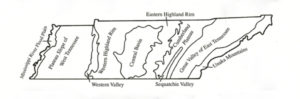
Figure 1. Physiographic provinces of Tennessee (Luther 1977).
Our knowledge of the prehistoric Indians of Tennessee is a consequence of over 150 years of archaeological investigations. Archaeology is the scientific subject area responsible for the recovery and estimation of the remains of by cultures. Modern archaeology has three bones objectives: get-go, employing excavations and analysis based on scientific principles, archaeologists seek to develop temporal sequences of past cultures; 2d, archaeologists seek to reconstruct the lifeways of past man societies; and third, archaeologists address the development and operation of cultural systems—topics such as the origins of agronomics and changes in political organization. Places where cultural remains are found are called sites, and these may be as simple as a location where several arrowheads are found and as complex every bit a ten acre village and mound complex.
Scanty written information nigh the Indians of Tennessee and the Southeast come from chronicles of the sixteenth-century Spanish (Hudson 1990), seventeenth-century French (Williams 1928), and eighteenth-century British expeditions (King 2007). Every bit Euro-American settlers moved west beyond Tennessee in the belatedly eighteenth and early nineteenth centuries, the many mounds and excavation they encountered became a focus of speculative interpretation, often based on scripture or comparison to cultures in other parts of the globe. The well-nigh pervasive was the theory of the Mound Builders which held that the ancient mounds were the remains of an extinct culture, likely the Canaanites and Lost Tribes of Israel (Silverberg 1968).
By the 1870s, antique collecting and speculation were replaced with more than systematic excavations in Middle (Jones 1876, Putnam 1878, Thruston 1890) and Due east (Thomas 1894) Tennessee and these clearly demonstrated that the prehistoric mounds and villages were constructed by the American Indians and that the occupants may accept been ancestors of historic tribes of the Southeast. By the 1920s, excavations fabricated it clear that many sites were occupied over fourth dimension past successive Indian groups (Harrington 1922).
With the cosmos of the Tennessee Valley Say-so in 1933, there began a massive archaeological recovery program using federal relief workers (CWA, WPA) in valleys to be inundated. Between 1934-1942, surveys and excavations were conducted in the Pickwick, Guntersville, Chickamauga, Kentucky, Watts Bar, Douglas, and Fort Loudoun reservoirs. In add-on, express excavations were conducted at the Obion, Link, Pack, and Mound Bottom sites in Heart and West Tennessee. This period saw the establishment of professional archaeology in the state and increased enormously our understanding of the prehistoric Indian occupations locally.
In the 1940s a technique to date organic fabric (charcoal, wood, bone, beat out) from archaeological sites was developed. Called radiocarbon dating (Libby 1955), archaeologists were now able to determine how long ago sites had been occupied—and suddenly the Indian occupation of Tennessee became very long.
The 1960s and 1970s saw a serial of land and federal laws enacted that are designed to protect, preserve, and manage archaeological sites (TCA 11-6-101et seq.,The Reservoir Salvage Act of 1960, National Historic Preservation Human activity of 1966, National Environmental Policy Act of 1969, The Archaeological and Celebrated Preservation Human activity of 1974, and the Archaeological Resource Protection Act of 1979). Amongst other things, these laws required that for whatever project on state or federal country, or that is funded by or permitted by land or federal agencies, the project must place and mitigate the impact on archaeological sites. Consequently, there has been an enormous amount of archaeological work done in Tennessee over the past forty years ranging from major reservoir projects such as the Tellico, Normandy, and Columbia, to route, bridge, sewer line, and transmission line projects.
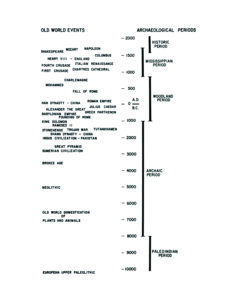
Archaeologists split up the time humans have been in eastern Tennessee into periods. These periods are both references to some span of time, and to some phase in a continuum of increasing social complication.
The upshot of the by 150 years of archaeological work is that we at present know a lot well-nigh the prehistoric Indian occupation of Tennessee. Archaeologists divide the fourth dimension people accept been in Tennessee into a series of major periods (Figure 2). These periods are both references to a span of fourth dimension and to a stage in a continuum of increasing social complexity. Ancient native peoples formed numerous and varied social and political groupings that changed through time during each of the archaeological periods. Although ancestral to native peoples of today, the ethnic and tribal affiliations of these ancient societies are unknown. The prehistoric peoples of Tennessee may well exist the ancestors of several southeastern tribes.
The First Tennesseans: The PaleoIndian Menstruum
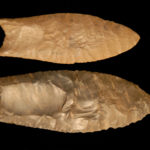
Figure 3. Clovis type spear points, lengths v.four and 4.7 inches. Ernest J. Sims Collection
One of the big problems in American archaeology is the peopling of the New World. The traditional explanation has been that during the last Water ice Historic period, the bounding main levels were as much as 300 feet lower than today thus exposing a dry land bridge across the Bering Strait from Siberia to Alaska. Effectually 13,000 years ago, bands of hunters with their families crossed into North America and radiated across the continent, their presence recorded past Clovis points (Effigy iii)—a distinctive lanceolate stone spear point with flutes or grooves on each face and named for the Clovis site in New United mexican states where they were found in association with extinct mammoths.
In the last two decades evidence has mounted that suggest an earlier, pre-Clovis inflow of people into the New World (Malakoff 2008). Monte Verde, a site in Chile, is dated 14,500YBP (Dillehay 1989, 1997). Human feces from Paisley Caves, Oregon, have been dated 14,300YBP (Curry 2008); and genetic studies comparing mod Native American genes to native Siberians show that the populations diverged xv-20,000 years agone (Goebel et al. 2008). These and other data indicate a engagement of fifteen,000+ YBP for the starting time of the PaleoIndian period.
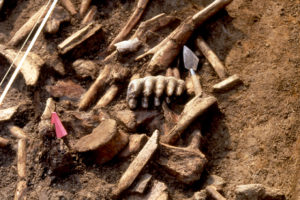
Effigy 4. Mastodon molar and bones at the Coats-Hines site.
Evidence for PaleoIndians in Tennessee comes primarily from finds of fluted spear points and other distinctive cutting and scraping rock tools. Over 1,000 fluted points have been found across the country and over 100 sites identified. Concentrations of these artifacts may indicate the location of base camps where a number of activities would have occurred. A particularly good example is the Carson-Conn-Short site in Benton County (Broster and Norton 1993), which contains over 40 hearths. The greatest concentration of prove for PaleoIndian occupation is the western valley of the Tennessee River and the Central Bowl particularly along the Cumberland River. This may be due to the high-quality chert resources in the western valley and the availability of mineral-rich soils, springs, and licks in the Central Bowl where animals such as the mastodon, an extinct Ice Age elephant, likely congregated (Breitburg and Broster 1994).
Ii sites show the direct association of humans with mastodons, At the Coats-Hines site in Williams County, thirty-iv stone artifacts were found with the remains of a juvenile male mastodon (Figure 4); stone tool cut marks were present on a vertebra (Breitburg et al. 1996). At the Trull site in Perry Canton (Norton, Broster, and Breitburg 1998), a modified section of a mastodon tusk was found.
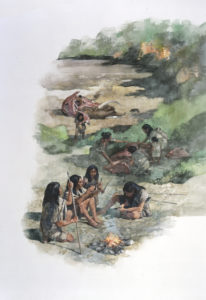 | Effigy 5, This scene is based upon the excavations at the Coats-Hines site in Williamson County, Tennessee, where two mastodon skeletons were found. Close examination of the basic showed that one showed articulate cut marks – evidence of the association of humans with this now extinct Ice Age elephant. In the foreground, men are repairing and remounting rock spearpoints onto foreshafts that tip spears used in hunting. In the background, a mastodon is being butchered in the marshy area where perhaps it had been trapped. The meat is being processed for both consumption and drying for future utilize.Painting by Greg Harlin. © McClung Museum of Natural History & Civilisation, The University of Tennessee, Knoxville. |
PaleoIndians have been often referred to as large game hunters, focusing on the now-extinct large animals of the concluding Ice Age (Figure 5). A more accurate description would be to telephone call them generalized foragers who supplemented their diet of plant foods and small game with an occasional opportunistic killing of a mastodon. To understand the cultural organization of the PaleoIndians, archaeologists expect at studies of living groups of foragers and construct theoretical models. Thus we believe that PaleoIndians were organized into bands in which several related families occupied and exploited a sure territory. A typical band may accept numbered xx to twenty-5 persons and been comprised of a female parent and male parent, their unmarried children, their married sons with their families, a few uncles and aunts, and a grandparent or ii (this assumes that the guild was organized along male lines; afterward societies were organized forth female person lines).
This social group had little political system except for a nominal leader chosen perhaps for his hunting prowess. The ring moved occasionally to take reward of the seasonal availability of sure plants and animals, but probably besides had a base camp where a greater portion of their fourth dimension was spent. Bands would join with other bands from time to fourth dimension to hunt game, to exchange items, or for marriage between groups. Religious beliefs probably focused heavily on a respect for and an caption of diverse natural forces. Of item importance would be ceremonies designed to assure success in the hunt and connected abundance of game. In times of sickness or stress, the band looked to a shaman who was idea to have received power from supernatural forces.
Habiliment can be causeless to take been sufficient for the environs in which the group lived. Similarly housing would range from simple lean-tos to more elaborate enclosures every bit the weather and mobility warranted. One must realize that these bands did not wander aimlessly. Their culture was an adaptation to any situation they encountered, and although band level social club seems "archaic" when compared to later more circuitous groups, it provided all the physical and spiritual needs of the group.
The PaleoIndian period saw climatic fluctuations that brought changes in the surroundings of Tennessee and the extinction of the remaining Ice Age animate being such every bit mastodons. Past 10,000 years ago the climate and vegetation had reached essentially modernistic weather producing changes in the ways the native peoples lived and sought nutrient. Archaeologists recognize this as the start of the Archaic menses.
The Archaic Catamenia
The Archaic catamenia spans 8,000 years (11,000–3,000 YBP), a long period of time which archaeologists divide into Early on, Heart, and Belatedly. Archaeological sites are numerous in the state indicating a population growth and exploitation of a wide range of resources and locales. Many of the Early Archaic sites have been plant securely buried in the alluvial floodplains of the major river valleys (Figure 6), camps preserved as the river bottoms congenital upwards by successive alluvion deposits over the millennia.
The Early on Archaic (10,000–8,000 YBP) was a fourth dimension during which bands of hunters and gatherers adapted to the postal service glacial environs. The shape of rock projectile points shift from lanceolate to basally side or corner notched (Figure 7), perhaps indicating the advent of the spear thrower – a brusque shaft with a hook at ane end which was inserted in the butt end of the spear thus serving as a lever to increase distance and thrust (Effigy 8). Social system continued to exist bands occupying base camps and ranging out to exploit various natural resources (Effigy 9). Equally populations increased, bands established territories within river valleys.
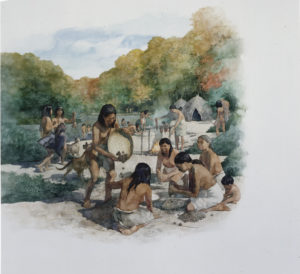 | Figure ix, Native Americans of the Primitive Period were hunters and gatherers, and their settlements reflect an adaptation to the abundant natural resources of the Tennessee region. Sites varied in function from base settlements to transient hunting or collecting camps. A base camp is shown here. In the foreground, women are processing hickory nuts. Found foods were supplemented by such animals every bit the white tail deer, turkeys, bears, and smaller game like rabbits.Painting by Greg Harlin. © McClung Museum of Natural History & Culture, The Academy of Tennessee, Knoxville. |
The textile culture of the Archaic people becomes more diverse over time with an assortment of stone and bone tools for a myriad of tasks. 1 must realize that for all the culture periods, we are missing a significant portion of the tape; except in rare instances, gone are the perishable materials – wood, fiber, feathers, hides, furs, and basketry. Housing prove is restricted to a few postholes; many hearths and storage pits remain equally mute show of residential sites. Analysis of human burials from the Middle and Late Archaic periods reveal an average life expectancy of 25 years. Evidently violence occurred perhaps related to groups vying to retain command over territory, every bit indicated past inflicted projectile points plant embedded in bodies and trauma preserved in the skeletal bear witness including show for scalping.
Throughout the Archaic menstruation and the residue of prehistory the major source of animal poly peptide for Tennessee Indians was the white-tailed deer. This staple was supplemented past blackness bear and a wide assortment of other mammals. The nigh unremarkably hunted birds were turkeys and passenger pigeons, and where arable along the flyways in the western part of the country, migratory waterfowl similar ducks and geese. Fish such as suckers, drumfish, and catfish were also eaten. Beginning in the Middle Archaic, freshwater mussels and gastropods were nerveless in enormous numbers, especially in the western Tennessee River valley. Massive heaps or middens of shell are plant along some of the major rivers of the state and betoken residential sites and , sometimes, where people were cached.
Gathering wild constitute foods was equally important every bit hunting, and of primary importance were nuts, particularly nuts and acorns. These first line found nutrient staples remained of import through all subsequent culture periods. Hickory nuts are loftier in fats and rough protein and require no special processing to render them edible. Acorns are high in fats and carbohydrates and complemented hickory nuts every bit a food source although the bitter tannic acid in them must exist leached out to make them edible. A wide range of other plants were collected by the Indians and through continued human choice became domesticated: a variety of squash/gourd (Cucurbita pepo ssp. ovifera) (Figure 10) is native to eastern Due north America and was utilized by Centre Primitive peoples around 7,000 years ago. In that location is considerable debate nearly when these cucurbits were actually domesticated, but there is consensus that cultivation of squash/gourd was occurring by iv,000 years ago. Carbonized seeds of domesticated sunflower (Helianthus annua) (Effigy 11) were institute at the Hayes site on the Duck River and dated to iv,315 YBP. Sumpweed (Iva annua) (Figure 12), some other cultigen important for its oily seeds, was domesticated nigh the same fourth dimension as sunflower. Chenopod or lambsquarters (Chenopodium sp.) (Figure thirteen), a small grain, was domesticated by 3,500 years ago and it is clear that some course of gardening was taking place by at least Late Archaic times.
Beginning around 6,000 years ago human population in the Primal Basin and western Tennessee River valley began to increase partly due to improved adaptive strategies for extracting food from the local environments. In some areas, gild became less egalitarian and a caste of social stratification emerged. Sure kinship groups were accorded more than power and prestige than others. The best archaeological evidence for this comes from the increased burying ceremonialism and marked differences between the way some individuals were treated. Closely related to social stratification was an increase in the interregional exchange of certain objects. Gulf and Atlantic marine shells (Effigy 14) and Lake Superior copper, apparently sought for their prestige value have been institute with burials of assumed loftier ranking individuals. In the Tardily Archaic, soapstone bowls derived from outcrops in the Appalachians and Georgia piedmont, occur in sites every bit far west as the Western Valley.
Woodland Menses
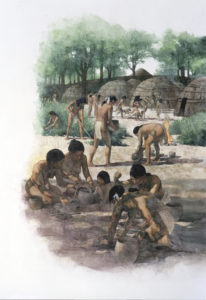 | Figure fifteen. The Woodland Menstruation is characterized by several important cultural advances – pottery, more permanent settlements, and increased reliance on gardening and domesticated plants – which are reflected in this scene based on research by University of Tennessee archaeologists in the Duck and Little Tennessee river valleys.Painting by Greg Harlin. © McClung Museum of Natural History & Culture, The Academy of Tennessee, Knoxville. |
The Woodland flow has been broadly characterized by the manufacture of pottery, the beginnings of intensive agriculture, and the construction of burial mounds and ceremonial excavation (Figure 15). The shift from an Archaic period fashion of life to that of Woodland civilization did not occur everywhere at the same time. Changes that had begun in the Archaic culminated in the Woodland and increasing population necessitated changes in political and social arrangement. Equally with the Archaic, the Woodland catamenia is divided by archaeologists into Early on (3000–2200 YBP), Heart (2200–1600 YBP), and Tardily 1600–1100 YBP).
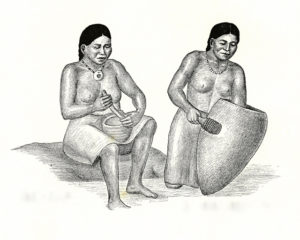
Figure xvi. Early Woodland pottery making. Cartoon by Madeline Kneberg. Courtesy The University of Tennessee Press.
The invention and use of pottery was an important event in man history. The oldest documented pottery is in the Jomon culture of Japan over 12,000 years ago. In the New World, pottery is at least 5,000 years quondam appearing showtime in Ecuador. In Tennessee, pottery is introduced from two sources. The earliest is a fiber-tempered and sand tempered ware associated with Late Primitive/Early Woodland cultures to the south and appearing start in southwestern Tennessee about 3000 YBP. The 2nd source of pottery manufacture may be the northeast U.S. and is identified past big conical containers with cord and fabric marked exteriors (Figure 16); this mode of pottery appears in upper E Tennessee by 2900 YBP. During the Woodland period, pottery manufacturing and container styles changed reflecting regional differences among Woodland cultures. The appearance of pottery in the archaeological record implies a degree of sedentarism, since being beefy and delicate, such vessels were difficult to send.
Some form of gardening was taking identify at least by Late Archaic times and was an of import function of the subsistence strategy by the Early on Woodland period. Paleoethnobotanist Richard Yarnell analyzed the contents of Early Woodland homo feces found in Salts and Mammoth caves in Kentucky and ended: "the relative proportions of plant foods in the diet during the period of about 650-250 BC was 40 percent oil-seed crops (sunflower, sumpweed, cucurbits), 36 per centum small grains (chenopod, maygrass, amaranth), 2 percent weedy greens (probably at to the lowest degree eight species), 2 percent fleshy fruits (at least ten species), and 20 per centum nuts (hickory, acorn, and hazlenut). Thus information technology appears that at to the lowest degree 75 percent of the constitute foods (and maybe ii-thirds of all foods) were from garden produce." (Yarnell 1993:17) Hunting, gardening, and foraging for wild plant foods connected to be important through the rest of prehistory. Corn, the mainstay of the American Indian throughout virtually of Northward America, was first domesticated in Mexico some 5000 years ago The first evidence for corn in the eastern U.Southward. is around 2300 YBP; in Tennessee, the earliest corn comes from eastern Tennessee and dates to 1825 YBP, merely it plain did non become a major part of the diet until the Mississippian period.
Early on in the Woodland menstruum, if not earlier in the later part of the Archaic, bands began to group together to form sociopolitical units called tribes. The tribe was fabricated upwards of several localized communities each of which were organized through a kinship group chosen a lineage. These lineages would come together from time to time for the purpose of warfare or ceremony. The social organization was essentially egalitarian and community leadership rested with individuals who exhibited prowess in hunting or warfare. Past the Centre Woodland period in that location is some bear witness that some people were born with more rights and privileges than others.
The structure of ceremonial earthworks and burial mounds began in the Late Archaic in the Southeast with the most impressive being Poverty Point in Louisiana (Figure 17). To the north of Tennessee, the Early Woodland Adena culture included burial mounds that independent tombs of likely lineage founders and burials of other kin. Although no Early on Woodland burial mounds take been constitute in Tennessee, there are burials that have been found that prove Adena influence in artifacts and the inclusion of body parts from multiple individuals, presumably kin.
Two sites in the Middle Woodland period stand up out in Tennessee. One, the Pinson site in Madison County, is a 395 acre circuitous consisting of at least 12 mounds (the largest is 72 feet high – Figure 18), a big geometric embankment, and habitation areas. Near were congenital between 2000 – 1800 YBP. The burial mounds incorporate tombs of credible high status individuals that may point an emerging chiefdom. The second site is Old Stone Fort in Coffee County which is a 50 acre plateau enclosed by 4,600 feet of stone and earthen embankments (Figure 19). Excavations suggest the enclosure functioned as a sacred space and the orientation of the entrance walls toward the summer solstice may signal a celestial function.
Centre Woodland cultures in Tennessee were engaged in some interaction with the Hopewell civilization to the northward. Excavations at Pinson in West Tennessee and at Icehouse Bottom in E Tennessee yielded pottery and stone tools of Ohio Hopewell origin. These sites were part of a broader substitution system amongst Eye Woodland peoples that reached as far south as Crystal River, Florida.
In the Late Woodland menstruum, there appears to be a collapse of the Eye Woodland interregional exchange systems and the abandonment of centers such equally Pinson and Old Stone Fort. Woodland communities, however, continued to thrive across Tennessee and the construction of burial mounds continues in eastern Tennessee (Figure 20). Although the applied science may have appeared earlier, the bow and pointer definitely came into widespread employ facilitating both hunting and warfare. Towards the cease of the Late Woodland, utilise of corn as an agricultural crop increases dramatically. By 1100 YBP a shift from Woodland to Mississippian lifestyles was occurring through either migration of new peoples or the diffusion of ideas from the Mississippian heartland in the middle Mississippi River valley. The dynamics of the change remain a topic of study.
Mississippian Catamenia
At its elevation, the Mississippian tradition is characterized by the post-obit: (one) the construction of earthen platform mounds on which were erected temples, elite residences, and council buildings (Figure 21); (2) the arrangement of mounds and private household structures around open plazas (Figure 22); (iii) increased population and more than stable settlements than in the preceding Woodland flow; (4) the emergence of organized chiefdoms; (five) increased warfare; (6) elaborate and well developed religious ceremonialism and symbolism; (7) a dependence upon new and improved strains of corn and the introduction of beans; and (8) morphological changes in ceramics and a fluorescence in ceramic styles.
As with the earlier culture periods, the Mississippian period is divided in to Early (1100-900 YBP), Middle (900–650 YBP), and Late (Advert 650–400 YBP) subperiods. Throughout the state mound centers/towns appeared, some quite large extending over several to several tens of acres, each with associated outlying hamlets and farmsteads. Many of these big sites bridge the Early, Middle and even Late periods as hamlet sizes grew and contracted and successive mound layers were added. Today many of the Mississippian sites are inundated past TVA reservoirs, but sites such every bit Chucalissa, Obion, and Shiloh in west Tennessee; Mound Bottom and Sellers in Middle Tennessee, and Hiwassee Island in eastern Tennessee yet remain. A state of affairs that is still not understood saw much of West Tennessee and parts of the Cumberland/Due west Tennessee River valley abased by the Tardily Mississippian catamenia. In eastern Tennessee, the Mississippian occupation continued into the early 1600s.
Increasing social complexity and population density had resulted in a sociopolitical level called a chiefdom. In such a organization, social organization was clearly stratified with one's position divers by hereditary ranking. The chief and his lineage and related lineages were set off from the residuum of the people, forming in a sense a hereditary nobility. Certain sites became centers from which the master would coordinate social, economic, and religious activities. These centers were continued through a web of alliances and were too ranked, with lesser centers discipline to a principal principal at a primary town.
In the Mississippian period warfare and alliances for war were a mode of life. Need for protection from raids is apparent in the structure of palisades and bastions around villages. While competition for limited prime agronomical state may have been a reason for warfare, the more probable motive is that warfare provided warriors a means for up mobility within a ranked society. Revenge and retaliation generated by alliances and kinship ties maintained frequent hostilities.
 | Figure 23. Decked out in their finery, the leaders of the Late Mississippian Period town of Toqua are assembled in front end of the civic buildings on the summit of Mound A. On the plaza earlier them a unmarried-pole stick ball game is in progress. The scene is based on inquiry by University of Tennessee archaeologists who excavated the Monroe County site in the 1970s. Information on vesture and ornament derive from artifacts and from images made by the Mississippian peoples themselves.The standard with the cantankerous served as a fan and sunshade and was an emblem of rank and importance, not a Christian symbol. This is documented by chroniclers of the 1539–43 trek of Hernando de Soto through the Southeast. The name, Toqua, comes from the historic Cherokee town of that name that subsequently occupied the aforementioned location.Painting by Greg Harlin. © McClung Museum of Natural History & Civilization, The University of Tennessee, Knoxville. |
In Mississippian villages the year would be accented with many ceremonies and activities in which music, dance, and ritual would be combined. These activities would be focused on the plaza and mound and would bring clan members from the surrounding hamlets to the mound centers. Social rank would be almost apparent at this fourth dimension and religious/political paraphernalia would be exhibited (Figure 23). Past 1100 a complex iconography had emerged that symbolically depicted deities, events, and religious concepts and these are manifest in an array of rock (Figure 24), shell (Figure 25), material, copper (Figure 26, and ceramic (Figures 27, 28) objects, and recent enquiry has identified a whole realm of cave art using iconographic designs (Figure 29) (Simek and Cressler 2008). An case of iconography can be seen in the circle and cantankerous motif in Figure 6 which is thought to stand for the four cardinal directions and the world (which was conceived every bit a round island). At the same time, the circumvolve symbolized the sun, 1 of the principal deities, and the cross symbolized the sacred fire.
The Mississippian menstruum was the last chapter in the long human prehistory of Tennessee. Throughout the Southeast it was the pinnacle of religio-socio-political complexity of the Native American societies. Beginning in the 16th century, European incursions into the interior by the Spanish, the French, and the English brought massive alter to the Indian cultures. Concrete brutality and the introduction of European diseases decimated the populations and these disruptions broke downward the traditional alliances and undermined the social and political order. By the tardily 1600s we accept left prehistory and entered recorded history. The story becomes ane of the Cherokee, Yuchi, Shawnee, Creek, Chickasaw, and others and their relationships with Euro-Americans and a new nation.
References
- Breitburg, Emmanuel and John B. Broster 1994 Paleoindian Site, Lithic, and Mastodon Remains in Tennessee.Current Research in the Pleistocene 11:9-eleven.
- Broster, John B. and Mark R. Norton 1993 The Carson-Conn-Short Site (40BN190): An Extensive Clovis Habitation in Benton County, Tennessee.Current Research in the Pleistocene 10:iii-v.
- Curry, Andrew 2008 Aboriginal Excrement.Archaeology 61(4):42-45.
- Folmsbee, Stanley J, Robert Corlew and Enoch L. Mitchell 1969Tennessee: A Brusk History. The University of Tennessee Press, Knoxville.
- Goebel, Ted, Michael C. Waters, and Dennis H. O'Rourke 2008 The Late Pleistocene Dispersal of Mod Humans in the Americas.Scientific discipline 319(5869):1497-1502.
- Harrington, K.R. 1922 Cherokee and Before Remains on Upper Tennessee River. Museum of the American Indian, Heye Foundation,Indian Notes and Monographs, Miscellaneous Serial No.24.
- Hudson, Charles 1990The Juan Pardo Expeditions: Exploration of the Carolinas and Tennessee, 1566-1568. Smithsonian Institution Press, Washington.
- Jones, Joseph 1876Explorations of the Aboriginal Remains of Tennessee. Smithsonian Contributions to Knowledge No. 259. Washington, DC
- King, Duane H. (editor) 2007The Memoirs of Lt. Henry Timberlake: The Story of a Soldier, Charlatan and Emissary to the Cherokees, 1756-1765. Museum of the Cherokee Indian Press, Cherokee, NC.
- Libby, Willard 1955Radiocarbon Dating. Academy of Chicago Press, Chicago.
- Luther, Edward T. 1977Our Restless Earth: The Geologic Regions of Tennessee. The University of Tennessee Press, Knoxville.
- Malakoff, David 2008 Rethinking the Clovis.American Archaeology 12(4): 26-31.
- Morgan, William N. 1999Precolumbian Architecture in Eastern North America. University Printing of Florida, Gainesville.
- Norton, Mark R., John B. Broster, Emmanuel Breitburg 1998 The Trull Site (40PY276).Current Research in the Pleistocene15:50-51.
- Putnam, Fredrick W. 1878Archaeological Explorations in Tennessee. Eleventh Annual Written report of the Trustees of the Peabody Museum of American Archæology and Ethnology 2 (2):305-360).
- Silverberg, Robert 1968Mound Builders of Ancient America: The Archaeology of a Myth. New York Graphics Lodge, Ltd.
- Simek, January F. and Alan Cressler 2008 On the Backs of Serpents: Prehistoric Cavern Fine art in the Southeastern Woodlands. In David Dye,Cave Archæology of the Eastern Woodlands: Essays in Accolade of Patty Jo Watson, pp. 169-191. The Academy of Tennessee Press, Knoxville.
- Thomas, Cyrus 1894Report on the Mound Explorations of the Bureau of Ethnology. Twelfth Annual Report of the Agency of Ethology, Washington.
- Thruston, Gates P. 1897Antiquities of Tennessee and the Adjacent States. 2nd Edition. The Robert Clarke Company, Cincinnati.
- Williams, Samuel Cole (editor) 1928Early Travels in the Tennessee Country, 1540-1800. The Watauga Press, Johnson
Urban center, Tennessee. - Yarnell, Richard A. 1993 The Importance of Native Crops during the Late Archaic and Woodland Periods. InForaging and Farming in the Eastern Woodlands, edited by C. Margaret Scarry, pp. thirteen-26. University Press of Florida, Gainesville.
milesyouldeld1943.blogspot.com
Source: https://mcclungmuseum.utk.edu/2009/01/01/prehistoric-american-indians/
0 Response to "6 One Notable Characteristic of Indians in the Archaic Age Was B Cave Art"
Postar um comentário